How Elon Musk’s Traffic Jam Tweet Turned Into a $7 Billion Company
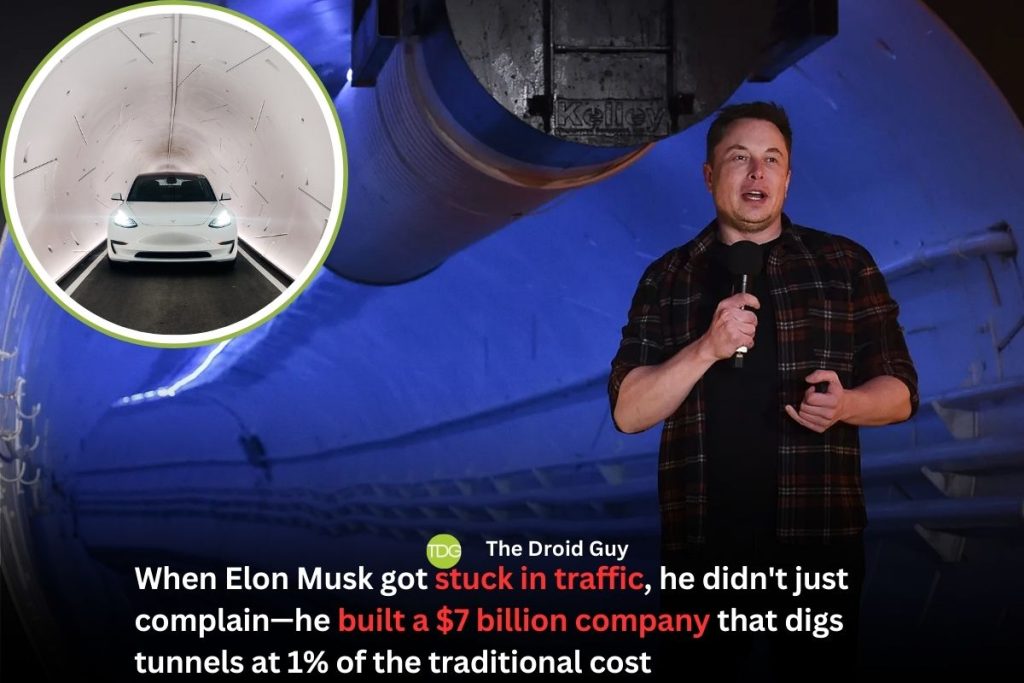
In December 2016, Elon Musk was stuck in Los Angeles traffic and fired off a throwaway tweet: he was going to build a tunnel boring machine and start digging. Two weeks later The Boring Company (TBC) existed on paper, and by April 2026 it has a roughly $7 billion private valuation, an operating people-mover under the Las Vegas Strip, and a pipeline of proposed projects that are either inching forward, stalled, or quietly cancelled. The headline “$7 billion from a tweet” is accurate — but the story underneath is messier and more interesting than the viral version.
From a Tweet to a Delaware LLC in Two Weeks
Musk’s original pitch was simple: stack tunnels vertically to eliminate surface traffic. What made the idea plausible wasn’t the concept — urban tunneling has existed for 150 years — but the claim that TBC could cut per-mile costs by an order of magnitude. Traditional subway tunneling in the U.S. runs roughly $100 million to well over $1 billion per mile depending on geology, station count, and local labor costs. TBC’s stated target was closer to $10 million per mile. Transit researchers (including the NYU Marron Institute’s Transit Costs Project) have flagged the comparison as apples-to-oranges — TBC’s tunnels are narrower, single-vehicle, and have far less station infrastructure — but the cost premise is what sold early backers.
Funded by $100M From Musk and 20,000 Flamethrowers
The company’s first round of roughly $112.5 million in 2017 came mostly from Musk himself (about $100 million). The rest famously came from selling 20,000 “Not-a-Flamethrower” units at $500 each — roughly $10 million in gross revenue and, more importantly, a viral marketing moment that put TBC on the map before it had poured any concrete. A later Series C in April 2022 added $675 million at a post-money valuation of $5.675 billion; subsequent secondary activity pushed the implied valuation to around $7 billion, where it has roughly sat since.
The Hawthorne Test Tunnel and Project Prufrock
TBC’s first physical proof-of-concept was a roughly 1.14-mile test tunnel under Hawthorne, California, opened to demonstrations in December 2018. The ride — a Tesla Model X on concrete “tracking wheels” at up to 40 mph — was not the 150+ mph promise from the original pitch, and critics were quick to point that out. What did come out of Hawthorne was Prufrock, TBC’s second-generation tunnel boring machine, which the company claims can advance roughly 1 mile per week versus the industry standard of 8 to 14 feet per day. Independent verification is scarce, but Vegas tunnel progress has been visibly faster than legacy TBM projects.
The Vegas Loop: Real, Operating, and Smaller Than the Pitch
The Las Vegas Convention Center (LVCC) Loop — a 1.7-mile, three-station people-mover with Teslas driven through the tunnels — opened in 2021 under a $52.5 million contract. It is TBC’s only fully operating commercial system. The larger Vegas Loop, approved by Clark County in stages starting 2021, is planned to reach roughly 68 miles and 93 stations. As of early 2026, approximately 7 miles of tunnel are complete and a handful of stations beyond LVCC are open — including stops at Resorts World, Westgate, Encore, and Riviera — with more under construction along the Strip and connecting to Harry Reid International Airport via a future extension.
The honest caveat: the experience is not a subway. Vehicles are individual Teslas with human drivers, top speeds are around 35–40 mph (not the hundreds of mph originally promised), and peak-hour throughput is a frequent criticism. Clark County regulators and the LVCVA have published throughput targets of about 4,400 passengers per hour for the LVCC segment at full staffing, which is orders of magnitude below a conventional heavy-rail subway line. Rider reports on Reddit’s r/vegas and r/transit have documented 10–30 minute station waits during major conventions.
Utility Tunnels: The Pivot That Actually Scales
The business case that moved TBC from “publicity stunt” to “infrastructure company” wasn’t passenger transit — it was utility tunnels. Underground pathways for water, power, fiber, and stormwater are a less glamorous market but a much larger one, and one where TBC’s narrower-bore, faster-TBM approach is a cleaner fit. Utility-tunnel contracts have been announced with municipal partners in Texas (around Bastrop and the Austin metro, adjacent to Musk’s Starbase and Tesla Gigafactory footprints) and are reportedly in discussion in Florida. The numbers here aren’t public, but utility work is the revenue line most analysts point to when justifying the company’s current valuation.
What Got Cancelled, Stalled, or Never Happened
A fair accounting requires the losses column:
- Hyperloop: Quietly discontinued. The Hawthorne test track was dismantled in 2022 and converted into parking. Musk confirmed the project was not moving forward.
- Chicago O’Hare Express: TBC was selected in 2018 for a $1 billion airport express tunnel. The project died under Mayor Lori Lightfoot and has not been revived.
- D.C. to Baltimore Loop: Proposed in 2017, granted early permits, no construction. Effectively stalled.
- Fort Lauderdale Beach Loop: Approved in principle in 2021, stuck in environmental review.
- Ontario Airport Loop (California): Proposed, no contract signed.
This is a long list of “no” for a company that pitched itself as a tunnel-building revolution. It also isn’t unusual for infrastructure — most proposed subway, light-rail, and HSR projects in the U.S. also die in permitting. The difference is that TBC’s pitch was explicitly that it would bypass the permitting and cost problems that kill conventional projects. That premise has not fully held up.
Safety and Regulatory Issues in Vegas
Clark County regulators have flagged repeated concerns over the Vegas Loop, including: the absence of dedicated emergency egress at several stations, ventilation and air-quality complaints from drivers, heat exposure in the tunnels during summer, and Tesla battery fire risk in confined space. Bloomberg and the Las Vegas Review-Journal have published multi-part investigations citing internal complaints from drivers about 12-hour shifts, bathroom access, and overheating vehicles. TBC has responded to some of these items; others remain open. For an infrastructure project operating under a gaming-and-tourism regulator rather than a traditional transit authority, the oversight structure itself is unusual — and is one of the reasons the project got built as quickly as it did.
Why It’s Still Worth $7 Billion in 2026
Three things justify the valuation even with the cancelled projects:
- Prufrock actually works. Whatever you think of the passenger-tunnel vision, TBC has a TBM that demonstrably bores faster and cheaper than legacy units in the sizes it targets. That IP alone has value to utility contractors, data-center builders, and municipalities.
- Vegas is a live reference customer. A working, paying, multi-station system with thousands of daily riders is a moat — even if the system is smaller and slower than promised.
- Musk-adjacent synergies. TBC tunnels connect naturally to Tesla manufacturing sites, SpaceX facilities, and potentially to data-center power/fiber needs that xAI and other ventures generate. Those are captive customers most startup infrastructure firms don’t have.
The Takeaway
The “tweet to $7 billion” narrative is true in the sense that the company exists, has revenue, and has a real valuation. It is misleading in that most of the original pitch — 150+ mph passenger tunnels, a Hyperloop, LA-wide underground highways, Chicago airport express — has either been abandoned or dramatically scaled down. What remains is a narrower, more boring (in both senses) infrastructure contractor that happens to be unusually good at digging narrow utility tunnels. That’s less cinematic than the 2016 version, but it’s the version that’s generating revenue in 2026, and it’s the version that justifies the current valuation.
The capital city of NY state is looking for raised bridge removal for water front accessibility . Elan”s company will be its best solution to relieve congestion.