Starlink Currently Provides The Best Inflight Wifi Experience And It’s Not Even Close
Starlink’s aviation service is the best inflight Wi-Fi available today, and the gap over legacy providers isn’t close. On well-equipped aircraft, passengers are pulling 100-250 Mbps per device — a 20 to 50x jump over the 5-15 Mbps ceiling most long-haul flights have offered for a decade. If you’ve flown a Qatar Airways 777, a Hawaiian Airlines A321neo, or a JSX Embraer recently, you’ve already felt the difference: video calls actually hold, 4K streaming works, and the Wi-Fi behaves like home broadband.
The honest caveat: coverage is still uneven. As of April 2026, only a minority of the global fleet is Starlink-equipped, adoption is moving aircraft-by-aircraft (not airline-wide overnight), and a handful of airlines — notably Delta — have publicly stuck with non-Starlink providers. Knowing which carrier and which tail number you’re flying matters more than ever.
Why Starlink Inflight Wi-Fi Beats Everything Else
Traditional inflight Wi-Fi was slow for two structural reasons: geostationary satellites sit roughly 35,786 km above Earth, and older Ku-band systems shared a narrow slice of bandwidth across hundreds of passengers. The result was high latency (600-800 ms round trip) and speeds that crawled once more than a few people logged on.
Starlink flips both problems. Its low-Earth-orbit (LEO) satellites sit at about 550 km, which cuts round-trip latency to roughly 40-60 ms — comparable to a decent terrestrial connection. The constellation also has far more capacity, and planes use phased-array antennas that electronically steer between satellites without moving parts. That’s why the speeds people are posting from 35,000 feet (100-250 Mbps is typical, with bursts above 300 Mbps on lightly loaded flights) are not marketing fluff — they’re what the architecture enables.
Which Airlines Actually Have Starlink in 2026
This is where honesty matters. Airlines announce Starlink deals years before passengers see the service onboard, because every plane needs a ground-up retrofit — antenna installation, FAA/EASA certification, and crew training. Below is a realistic picture of who’s actually flying with it right now versus who’s still rolling out.
| Airline | Status (April 2026) | Cost to Passenger |
|---|---|---|
| JSX (US regional) | Fleet-wide — first US carrier to offer Starlink (2023) | Free |
| Hawaiian Airlines | Available on A321neo, A330, and 787-9 fleet | Free |
| Qatar Airways | Rolling out across 777 and A350 fleet; started Oct 22, 2024 | Free in all cabins |
| United Airlines | Retrofits underway on regional jets; mainline rollout in progress | Free for MileagePlus members |
| Air France | Progressive rollout announced; limited availability on long-haul | Free for Flying Blue members (tiered) |
| WestJet | Rollout announced, limited aircraft equipped | Free |
| Air New Zealand | Rollout announced | TBD |
| Delta Air Lines | Does NOT offer Starlink; uses Viasat (free for SkyMiles members) | Free for SkyMiles members |
| American Airlines | Mostly Viasat/Intelsat; no broad Starlink commitment | Varies, ~$8-19 per flight |
| Southwest Airlines | No Starlink; uses Anuvu/Viasat | $8 day pass |
Translation: if free, usable inflight Wi-Fi is a priority, the surest bet is JSX (if your route fits), Hawaiian to/from the islands, or Qatar Airways on long-haul. On United, check the aircraft type before booking — the retrofit is aircraft-by-aircraft and not every flight has it yet.
What Real Speed Tests Look Like at 35,000 Feet
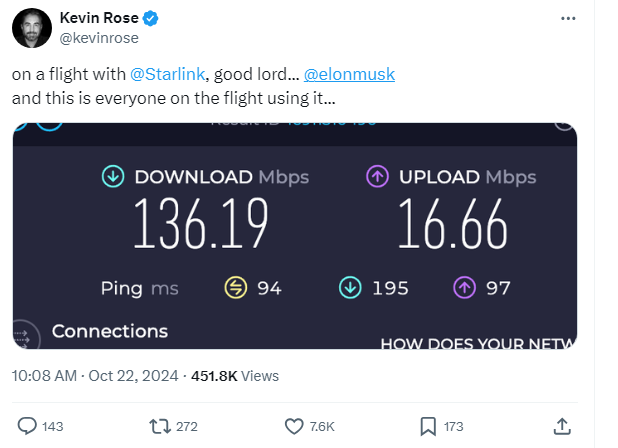
Tech entrepreneur Kevin Rose posted one of the early viral speed tests in October 2024 — 136 Mbps down, 16 Mbps up on a JSX flight, during a time when the entire cabin was connected. Since then, Reddit threads in r/starlink, r/aviation, and airline-specific subreddits have filled with similar results. A representative sample from community posts:
- Qatar Airways 777 (DOH-LHR): 180-215 Mbps down, 20-30 Mbps up, ~35 ms latency
- Hawaiian A321neo (HNL-LAX): 80-150 Mbps down depending on load, ~50 ms latency
- JSX Embraer (regional US): 120-200 Mbps down consistently
- United E175 regional: 90-130 Mbps down on equipped aircraft
Compare that with what Viasat, Intelsat/Gogo 2Ku, and Panasonic typically deliver: 5-25 Mbps down, latency often over 700 ms, and noticeable degradation as the cabin fills up. Zoom calls on those systems are a coin flip. On Starlink, they just work.

What Actually Works on Starlink Inflight Wi-Fi
This is the category where Starlink stops feeling like a novelty and starts feeling like overkill in a good way:
- Video calls: Google Meet, Zoom, FaceTime, WhatsApp video — all stable, even with multiple people in the cabin doing the same thing
- 4K streaming: Netflix, YouTube, Disney+, HBO Max stream without buffering; some airlines’ terms of service discourage it but the connection supports it
- Cloud gaming: GeForce NOW and Xbox Cloud Gaming are playable on well-loaded flights — a first for inflight Wi-Fi
- Large file transfers: Cloud uploads that used to be impossible (video exports, RAW photo batches) finish mid-flight
- Real-time collaboration: Google Docs, Figma, and shared cursors behave normally
The Real Limitations Nobody Mentions
Articles that gush about Starlink inflight Wi-Fi rarely mention the caveats. Here they are:
- Polar route gaps: Starlink coverage is weaker at extreme latitudes. Flights routing over the North Pole (SFO-SIN polar, NRT-JFK polar) may see degraded service in the highest segments until the Gen 3 constellation fills in.
- Takeoff/landing dead zone: Service is off below 10,000 feet on most carriers due to regulatory rules, same as any inflight Wi-Fi system.
- Content filtering: Most airlines still block adult content, BitTorrent, and VoIP calls at the network level, even though the bandwidth would support them.
- Aircraft-specific: Even on an “equipped” airline, you may board a plane that hasn’t been retrofitted yet. Until rollout completes, it’s a gamble — check flightradar24 or the airline’s fleet tracker before booking if Wi-Fi is a dealbreaker.
- Saturation is rare but possible: On a packed 777 where most of the cabin is streaming, speeds will drop from ~200 Mbps to ~40-80 Mbps per device. Still 10x better than legacy systems, but not unlimited.
How to Tell Before You Board
Because rollouts are aircraft-by-aircraft, the fastest way to confirm Starlink is onboard your specific flight is:
- Note the aircraft type and tail number from your booking confirmation or the airline app.
- On United, look for “Starlink Wi-Fi” language in the flight details; on Hawaiian, the A321neo and newer widebody aircraft are the safe bet; on Qatar Airways, 777s and A350s retrofitted since late 2024 are equipped.
- Airlines typically put a “Starlink” decal near the boarding door on retrofitted jets — it’s the quickest tell once you reach the gate.
- When you connect onboard, the captive portal will usually say “Starlink” or “powered by Starlink” if you’re on the new system.
What’s Next: Gen 3 Satellites
SpaceX’s Gen 3 Starlink satellites, which are being deployed via Starship, are larger (roughly 29 x 13 feet), carry more powerful antennas, and can deliver multi-gigabit downlink capacity per satellite. They orbit at approximately 350 km altitude — lower than the current Gen 2 constellation — which further drops latency into the single-digit-millisecond range for line-of-sight hops. For inflight Wi-Fi, the practical payoff is more headroom during peak hours and better performance on polar and transoceanic routes once coverage is filled in.
Realistically, the bottleneck isn’t the satellites at this point — it’s how fast airlines can retrofit their fleets. Major carriers take years to fully equip hundreds of aircraft. Expect the Starlink-vs-legacy gap to be the defining inflight Wi-Fi story through at least 2027.
The Bottom Line
Starlink’s inflight Wi-Fi isn’t just faster than the competition — it changes what you can actually do on a plane. Video calls, cloud gaming, 4K streaming, and real-time collaboration all work the way they work at home. The honest catch is availability: fewer than half the world’s commercial aircraft have been retrofitted, and one of the largest US carriers (Delta) is staying with Viasat for the foreseeable future. If free, fast inflight Wi-Fi is a must-have, book JSX, Hawaiian, Qatar Airways, or a Starlink-equipped United flight. Otherwise, the old rule still applies: download your content before you board.