The Best NEMA 6-20 Level 2 EV Chargers for Home in 2026
If you drive an EV but don’t have the panel space (or budget) for a 50-amp NEMA 14-50 install, a NEMA 6-20 Level 2 charger is the smartest middle ground in 2026. It pulls 240 volts at 16 amps from the same outlet style your dryer or window AC already uses, runs on a standard 20-amp double-pole breaker, and adds roughly 9 to 12 miles of range per hour — about three times faster than the Level 1 brick that came in your trunk. Below are the chargers actually worth buying right now, with the trade-offs spelled out before the affiliate links.
| Product | Brand | Name | Price |
|---|---|---|---|
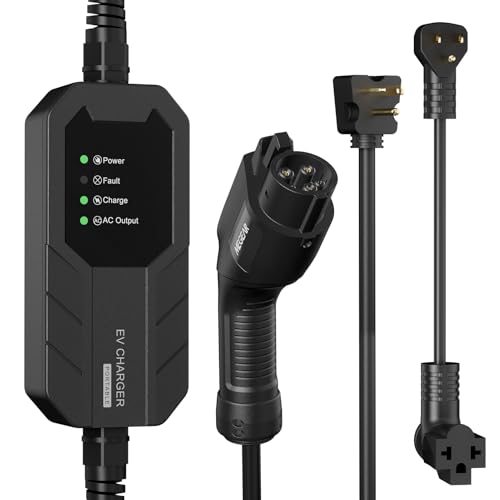 | MEGEAR | MEGEAR Skysword EV Charger | Check Price on Amazon |
 | AEFA | 20 Amp Outlet | Check Price on Amazon |
 | Asani | Asani EV Charger | Check Price on Amazon |
* If you buy through links on our site, we may earn an affiliate commission. For more details, please visit our Privacy policy page.
At a Glance: NEMA 6-20 Level 2 Chargers Compared
| Charger | Max Amps | Cable Length | Adjustable Amperage | Best For |
|---|---|---|---|---|
| MEGEAR Skysword | 16A | 25 ft | No | Budget set-and-forget charging |
| AEFA Adjustable Level 2 | 16A | 25 ft | Yes (10A / 13A / 16A) | Older homes with weak panels |
| Asani Level 2 EV Charger | 16A | 25 ft | Yes | Renters who want a portable kit |
| BougeRV Portable EV Charger | 16A | 21 ft | No | Garage installs with short reach |
| ShockFlo Portable EV Charger | 16A | 25 ft | Yes | Mixed Level 1 / Level 2 use with adapters |
All five are J1772-compliant, which means they work with every major EV sold in North America except the Tesla Model S/3/X/Y, which need the standard Tesla-supplied J1772-to-NACS adapter. None of them are “smart” chargers in the Wi-Fi/app sense — at this price tier, you are buying a reliable cable, not a connected hub. If app control or load balancing is non-negotiable, you have outgrown the NEMA 6-20 category and should look at hardwired 32A+ chargers instead.
What a NEMA 6-20 Level 2 EV Charger Actually Is
“NEMA 6-20” is a plug standard, not a brand or feature. The plug has two horizontal flat blades and a round ground pin, rated for 240 volts at 20 amps. The charger itself is a Level 2 EVSE (Electric Vehicle Supply Equipment) that draws up to 16 amps continuous — code requires you derate by 80% on a 20-amp circuit — and delivers about 3.84 kW to the car.
In practical numbers, that means roughly 9 to 12 miles of range per hour for an efficient EV like a Chevy Bolt EUV or Tesla Model 3 RWD, and 7 to 9 miles per hour for heavier vehicles like a Ford F-150 Lightning or Rivian R1T. A typical commuter who plugs in overnight will recover 80 to 120 miles between bedtime and breakfast — more than enough for the average 37-mile US daily drive.
The reason this category exists at all is wiring economics. A NEMA 14-50 install for a 40A or 48A charger almost always requires a licensed electrician to pull a new 6 AWG circuit from your panel, and many older panels in the US simply cannot accept another 50A double-pole breaker without a service upgrade. A NEMA 6-20 outlet, by contrast, can usually be added to an existing 20A double-pole circuit (the kind already running window air conditioners, baseboard heaters, or some compressors) and runs on much cheaper 12 AWG copper.
Key Features to Check Before You Buy
Five things matter, and most product listings bury them under marketing copy.
Adjustable amperage. A charger that lets you dial down to 10A or 13A is genuinely useful if your circuit is shared, your wiring is older 14 AWG (rated for 15A), or you are plugging into a non-dedicated outlet. Without adjustability, the charger pulls a fixed 16A and trips weak breakers.
Plug interchangeability. Several models in this category ship with a NEMA 6-20 plug attached and include adapters for NEMA 5-15 (standard 120V), NEMA 5-20, NEMA 14-50, and 6-15. If you move, rent, or want the option to use Level 1 charging at 120V occasionally, an adapter kit is worth the extra $20 to $40.
Cable length. 25 feet is the de facto standard. Anything under 20 feet is too short for most garage layouts unless you are parking nose-in directly under the outlet.
Certification. Look for UL, ETL, or Intertek listings on the EVSE itself — not just on the cable. Uncertified chargers have caused enough garage fires that some homeowner’s insurance policies now ask. Recent NFPA fire reporting has flagged uncertified portable EVSEs as a contributing factor in residential charging fires.
Built-in protections. The bare minimum to expect in 2026 is over-current, over-voltage, under-voltage, over-temperature, ground fault (CCID20), and surge protection. Any charger missing CCID20 ground fault detection should be rejected outright.
The Best NEMA 6-20 Level 2 EV Chargers for 2026
1. MEGEAR Skysword Level 1-2 EV Charger
Best overall budget pick. The MEGEAR Skysword is the charger that quietly shows up in most “I just bought a used Bolt” Reddit threads, and it earns the recommendation. It ships with a NEMA 6-20 plug, a NEMA 5-15 adapter for 120V Level 1 use, and a 25-foot cable. At 16 amps continuous, it adds about 10 miles of range per hour to most EVs.
The downsides are honest. There is no adjustable amperage, no display screen (just status LEDs), and the cable is on the stiff side in cold weather. Build quality is plastic-shell consumer-grade — fine for a covered garage, less ideal for an exposed carport in a freeze-thaw climate.
Pros: Affordable, reliable, dual voltage (120V/240V), J1772 universal fit, includes carry bag.
Cons: No adjustable amperage, no LCD, stiff cold-weather cable.
2. AEFA Adjustable Level 2 Charger
Best for older homes. The AEFA’s headline feature is the three-step amperage selector (10A, 13A, 16A) directly on the in-line controller. If your panel is 1990s vintage or you are sharing a circuit with anything else, the ability to drop to 10A removes guesswork — and the charger remembers the last setting after a power cycle, which not every adjustable competitor does.
It includes a NEMA 6-20 plug and adapters for 5-15 (120V) and 14-50 (240V/50A), so the same unit can travel between a vacation home, a destination L1 outlet, and a high-amp Airbnb without a separate cable. The four-color LED display reports input voltage, output current, charging time, and fault codes in plain English (over-current, over-temp, ground fault) — much friendlier diagnostics than the blinking-light languages most cheaper chargers use.
Pros: Three adjustable amperage levels, multi-plug adapter kit, clear LCD diagnostics, 25-ft cable.
Cons: Slightly bulkier in-line box than competitors, adapters add cost if not bundled.
3. Asani Level 2 EV Charger
Best for renters. The Asani is functionally similar to the AEFA — adjustable amperage, multi-plug adapters, J1772 — but the case is noticeably more compact and the carry bag is one of the better-padded ones in this price range. For people who are charging at apartments, parking garages, or relatives’ houses on weekends, the difference between “fits in a glovebox” and “lives in the trunk forever” matters.
The 25-foot SAE J1772 cable is rated for 110V to 240V input across the 6-20, 5-15, and 14-50 plug ranges with the included adapters. Asani publishes detailed protection specs (over-voltage, under-voltage, over-current, over-temperature, ground fault, lightning surge, leakage) which most no-name competitors do not.
Pros: Compact, well-padded carry case, multi-plug adapters, transparent protection specs.
Cons: Smaller brand with thinner long-term Reddit feedback than MEGEAR.
4. BougeRV Portable EV Charger
Best for short-reach garage installs. BougeRV is better known in the off-grid and RV solar world, and the company brings that same “treat the cable like real outdoor gear” philosophy to its EVSE. The shell is rated IP66 against dust and water jets — overkill for a closed garage, but exactly right for a carport, driveway pedestal, or covered exterior outlet in a wet climate.
The 21-foot cable is two to four feet shorter than competitors, which is a deliberate trade for less coiled clutter when the run is short. If your outlet sits within 15 feet of where the car parks, the shorter cable is genuinely easier to live with.
Pros: IP66-rated for outdoor use, robust strain relief, NEMA 6-20 default plug.
Cons: 21-ft cable too short for some layouts, fewer adapters bundled by default.
5. ShockFlo Portable EV Charger
Best for mixed Level 1 / Level 2 use. The ShockFlo is the charger to buy if you genuinely use both 120V and 240V outlets on a regular basis — for example, charging slowly on a 5-15 in the office parking lot during the day and quickly on a 6-20 at home overnight. Switching between the two does not require unplugging adapters mid-circuit; the controller detects input voltage and adjusts the output current accordingly.
It also includes a delayed-charge timer (1, 3, 5, 7, or 9 hours) which is useful for time-of-use electricity plans where overnight rates drop after 9pm or midnight. Cable length is the standard 25 feet, and the controller is one of the lighter ones in this comparison at roughly 7 pounds total kit weight.
Pros: Auto-detects 120V vs 240V input, built-in delay timer, lightweight kit.
Cons: No LCD (LED indicators only), timer settings reset on power loss.
Installing a NEMA 6-20 Outlet: What You Actually Need
Most people buying a NEMA 6-20 charger do not already have a NEMA 6-20 outlet, despite what marketing copy suggests. Here is the realistic install path for a typical US suburban home.
1. Confirm panel capacity. Open your main panel and count the empty breaker slots. You need two adjacent open spaces for a double-pole 20A breaker. If your panel is full, you will need either a tandem breaker (only allowed in panels rated for them — check the panel label) or a subpanel.
2. Measure the run from panel to outlet. 12 AWG copper is rated for 20A circuits up to about 100 feet without significant voltage drop. Above that, you should size up to 10 AWG. Aluminum wiring is not recommended for charging circuits regardless of length.
3. Use a dedicated double-pole 20A breaker. Do not share the circuit with anything else. EV chargers run at 80% of breaker rating continuously for hours — sharing the circuit will trip the breaker repeatedly.
4. Install the receptacle within sight of the parking spot. NEC 625.43 requires a means of disconnect for the EVSE. A standard NEMA 6-20 receptacle within sight of the charger satisfies this — no separate disconnect switch is needed for portable EVSEs that simply unplug.
5. Hire a licensed electrician unless you genuinely know what you are doing. Quotes for a NEMA 6-20 install in 2026 typically run $300 to $700 in major US metros, depending on the run length and panel work needed. That is roughly half the cost of a comparable NEMA 14-50 install.
Safety Warnings That Apply to Every Charger Here
Portable EV chargers are dragged across concrete, kicked by car doors, and left out in weather they were never spec’d for. The recurring failure modes on these are predictable.
Melted plug ends. Caused by loose receptacle contacts (worn outlets) or a partially inserted plug. If the plug feels even slightly warm to the touch after an hour of charging, stop. Replace the receptacle (a $4 part) before resuming. Do not “test it again to see if it gets worse.”
Cable damage. The most common failure is at the strain relief where the cable enters the controller box or J1772 connector. Inspect both ends every few months. Any cracked outer jacket or exposed inner wires is an immediate retire-the-charger event.
Ground fault trips that won’t reset. If your charger keeps tripping the CCID20 ground fault, the issue is almost never the charger — it is moisture in the J1772 handle, the car’s onboard charger, or the receptacle. Dry the J1772 connector, try a different receptacle, and only after both fail consider RMAing the charger.
Adapter chains. Never daisy-chain adapters. NEMA 5-15 to 6-20 to 14-50 adapter stacks are responsible for a disproportionate share of charging-related fires. If the outlet you have is not the outlet your charger needs, change the outlet — do not add adapters.
Our Recommendation by Use Case
If you just want it to work and don’t want to think about it: MEGEAR Skysword. It is the most-deployed charger in this category for a reason — it just runs.
If your house was built before 1995 or you have a sketchy panel: AEFA Adjustable. The 10A setting will save you a panel upgrade in many cases.
If you charge in multiple locations weekly: Asani Level 2. The compact case and adapter bundle pay for themselves in convenience within a month.
If your charger lives outside or in a wet climate: BougeRV. The IP66 rating is the only one in this list rated for sustained outdoor exposure.
If you split time between 120V and 240V outlets: ShockFlo. The auto-detect feature genuinely matters when you switch back and forth.
All five chargers ship with the standard SAE J1772 connector. Tesla owners (Models S, 3, X, Y, Cybertruck) need the J1772-to-NACS adapter that came with the car or is sold by Tesla and Lectron. Tesla’s own Mobile Connector and Wall Connector use NACS natively and are not interchangeable with this list.
Spot-check every Amazon link before checkout — listings in this category change frequently as smaller brands rebrand or run out of stock. Prices typically run $130 to $250 for the units listed here as of 2026, with the AEFA and Asani sitting at the higher end of that range and the MEGEAR consistently the cheapest of the five.