Anthropic Bans OAuth Tokens from Consumer Plans in Third-Party Tools
Anthropic has officially banned users from extracting OAuth tokens from their Claude consumer subscriptions (Free, Pro, and Max plans) to use in third-party tools and applications. The move, which the company quietly updated in their documentation, has sparked outrage among developers who view it as a betrayal of the AI company’s previously developer-friendly stance.
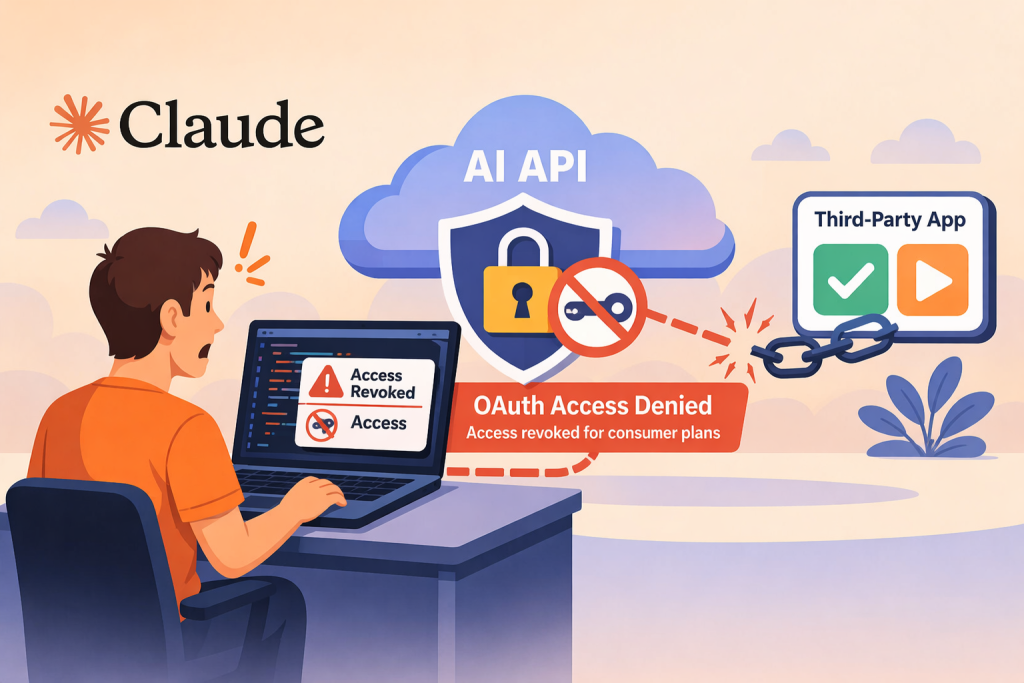
The Policy Change
According to Anthropic’s updated Consumer Terms of Service, using OAuth tokens obtained through Claude Free, Pro, or Max accounts in any other product, tool, or service — including the Agent SDK — is now explicitly prohibited and constitutes a terms of service violation.
The company clarified that OAuth authentication is intended exclusively for Claude Code and Claude.ai. Developers building products that interact with Claude’s capabilities should use API key authentication through Claude Console or a supported cloud provider instead.
Why This Matters
The ban targets a popular workaround where developers and power users would extract their OAuth tokens from Claude consumer accounts to use in third-party tools like OpenClaw, Zed, or custom-built applications. This allowed them to access Claude’s models at consumer subscription rates rather than paying the higher per-token API pricing.
The $200/month Max subscription offers over 90% discount on Opus compared to API pricing, which made the workaround particularly attractive for heavy users.
Developer Backlash
The developer community has reacted strongly to the policy change. Many feel betrayed, pointing out that Anthropic previously seemed to encourage using subscription tokens in custom tools. The ban has been described as greedy, anti-developer, and a departure from the company’s previously collaborative relationship with the developer community.
They gave explicit instructions how to do it back in November when they published that long-running agent harness, one developer recalled. This was the one where they demoed rebuilding Claude Web from specs in a 24-hour loop.
Others note the abrupt enforcement has damaged trust. Just can’t trust Anthropic to rug pull us if we do something they don’t like, wrote one developer. And they seem to not like quite a lot.
What’s Actually Banned
The prohibition covers:
- Using OAuth tokens from consumer plans in third-party tools
- Routing requests through Free, Pro, or Max plan credentials in custom applications
- Using consumer subscription tokens with the Agent SDK
- Any automated or non-human access through extracted tokens
Notably, the policy does not apply to API key authentication, which remains available through Claude Console at standard API pricing.
Enforcement and Consequences
Anthropic has stated they reserve the right to take measures to enforce these restrictions without prior notice. Several users have already reported account bans and suspensions for violating the new policy, with some losing access to their accounts entirely without refund.
The company can detect abuse through traffic pattern analysis, as requests originating from third-party tools often exhibit different behavioral signatures than those coming from official Claude Code clients.
Developer Alternatives
For developers affected by the ban, Anthropic recommends migrating to the official API with proper API key authentication. However, this comes with significantly higher costs — Sonnet API usage can run $10 in a couple of minutes under heavy load, with Opus potentially reaching $5,000 per day at sustained usage.
Some developers are now exploring alternatives:
- OpenAI Codex: Some report switching to Codex, which offers different pricing models
- Local models: Running open-source models locally via proxies
- OpenRouter: Accessing various models through a unified API
- Google AI Studio: Using free API tiers with Anthropic models where available
Business vs. Consumer Plans
It’s worth noting that the ban specifically targets consumer plans (Free, Pro, Max). Business and Enterprise plans have different terms and may offer more flexibility for development use cases. However, these come at significantly higher price points that individual developers may find prohibitive.
The Bigger Picture
This policy shift reflects the growing tension between AI companies’ consumer and developer businesses. Consumer subscriptions are often loss leaders designed to onboard users to official products, while API access represents the actual revenue-generating business model for production use.
As one developer observed, They’re losing money on those plans to get people to use Claude Code, so it makes sense they don’t want you taking the plan to other tools.
However, the abrupt enforcement has damaged trust with the developer community, with many now questioning whether they can rely on Anthropic for long-term projects.
What This Means for Users
If you’re a Claude subscriber:
- Your consumer plan is now restricted to official Anthropic clients only
- Using extracted OAuth tokens in third-party tools risks account termination
- For development work, you’ll need to migrate to API keys with pay-per-use pricing
- Business and Enterprise plans may offer alternatives but at higher cost
The move underscores a broader trend in the AI industry: the era of subsidized, unrestricted API access through consumer plans is coming to an end as companies seek sustainable business models.